

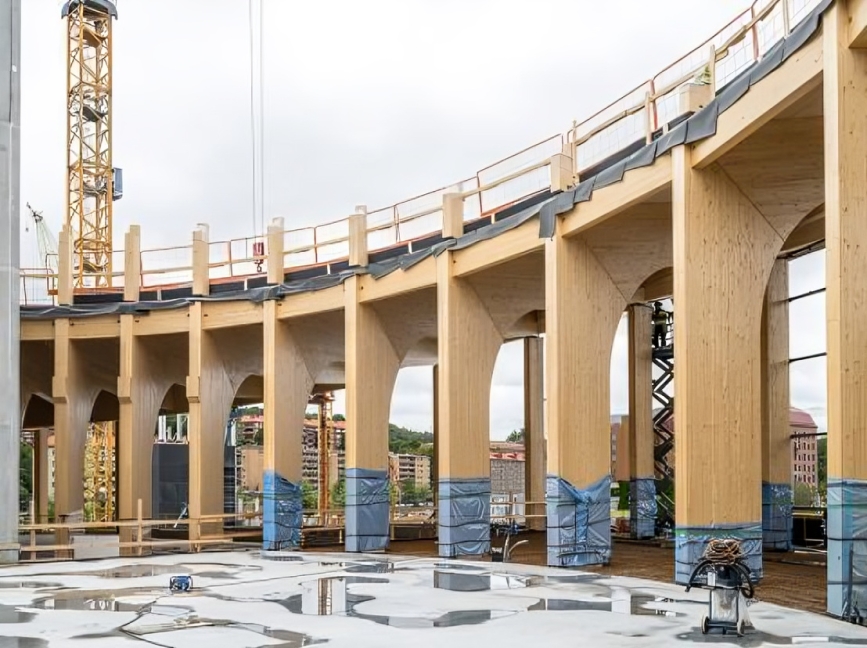
Henning Larsen has designed the new World of Volvo for Volvo Cars and Volvo Group in Gothenburg, marking a major milestone in large-scale sustainable timber architecture.
Spanning 20,500 square meters, the project demonstrates how mass timber construction and experiential design can merge to create a new generation of public cultural and brand spaces. The development reflects a growing global shift toward sustainable architecture using engineered wood systems and biophilic design principles.

Timber Architecture Inspired by Nature
At the core of World of Volvo is an advanced structural system built using glulam and cross-laminated timber (CLT), representing one of the most prominent examples of contemporary mass timber engineering in Europe.
The building’s structural concept is defined by three tree-inspired columns that branch outward in a mathematically precise pattern, supporting the roof and forming a dramatic canopy-like interior. This design creates a forest-inspired spatial experience that reinforces the project’s connection to nature, Scandinavian design traditions, and biophilic architectural principles.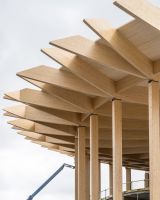
The architectural language reflects a broader movement in Nordic design that emphasizes sustainability, material honesty, and environmental integration in large-scale public buildings.
Immersive Experience Center for Mobility and Innovation
World of Volvo is envisioned as more than an exhibition space, functioning as an immersive experience center that brings together Volvo’s automotive and industrial heritage. The facility is designed to showcase innovation in mobility, engineering, and sustainability through interactive exhibitions and public engagement spaces.
By combining storytelling, technology, and architecture, the project aims to create a destination that communicates Volvo’s brand values while offering visitors an engaging cultural and educational experience.
The design also highlights how corporate architecture is evolving into experiential environments that merge branding, public interaction, and sustainable design thinking.
Collaboration Across Engineering and Construction Partners
The project was delivered through collaboration with multiple engineering and construction specialists, including BRA Group, WIEHAG Timber Construction, Lindner Scandinavia AB, BRA Teknik AB, BRA Mark, and Optima Engineering AB.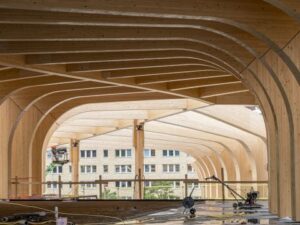
These partners played a key role in executing the complex timber structure, which required advanced coordination between architectural design, structural engineering, and precision fabrication techniques. The use of engineered wood systems reflects increasing industry confidence in timber as a scalable and sustainable construction material for large public buildings.
Advancing the Future of Mass Timber Construction
World of Volvo highlights the growing global adoption of mass timber as a viable alternative to steel and concrete in large-scale architecture. Engineered wood systems such as glulam and CLT are increasingly being used to reduce carbon emissions while maintaining structural strength and design flexibility.
The project’s tree-like structural system also demonstrates how computational design and advanced engineering can be combined to create efficient, expressive, and environmentally responsive buildings.
As sustainability becomes a central priority in architecture and construction, timber-based developments like World of Volvo are shaping new benchmarks for climate-conscious design and urban development.

 Share your work with Architecture Pulse. Upload your PDF below.